
Property risk underwriting · India
Verified property risk decisions for Indian insurers.
imaarat.ai reads hand-filled proposals in Indian languages, checks what each one declares against official hazard data for its PIN code, and gives your underwriter a scored, explained decision to sign off.
- हिन्दी
- বাংলা
- తెలుగు
- मराठी
- தமிழ்
- اردو
- ગુજરાતી
- ಕನ್ನಡ
- ଓଡ଼ିଆ
- മലയാളം
- ਪੰਜਾਬੀ
- +14 more
- PIN codes covered, metro to rural
- 19,312
- PIN codes covered, metro to rural
- public hazard datasets
- 11
- public hazard datasets
- Indian languages, plus English
- 25
- Indian languages, plus English
- from proposal to decision
- < 1 min
- from proposal to decision
Checked against public data from
- India Post
- BIS IS 1893
- NRSC, ISRO
- NDEM
- IMD
- data.gov.in
- Chennai and Bengaluru city corporations
Declared is not the same as verified.
Proposals are filled in by the people asking for cover. imaarat.ai checks what they declare against sources they do not control.
Earthquake zone
If a proposal states a lower zone than the IS 1893 map gives for its PIN code, the official zone is scored and the case is flagged.
Flood history
Satellite-observed flooding from 1998 to 2022, and flooding spots published by city corporations, are added even when the proposal is silent.
Cyclone exposure
Properties in districts that the India Meteorological Department lists as cyclone-prone are flagged automatically.
The live portfolio shows how many proposals understate their hazards.
From paper proposal to signed-off decision.
Six steps. Each one is recorded and can be inspected later.
Step 1 of 6
Intake
Type the proposal, or photograph the one-page paper form. AI reads the fields in the proposer’s language, and a person confirms each value before it is used.
Step 2 of 6
Verification
The PIN code brings in the official earthquake zone, flood history, cyclone exposure and known city flooding spots, each with its source.
Step 3 of 6
Scoring
Written underwriting rules score the risk and show every point: which hazards added risk and which protections took it away.
Step 4 of 6
Explanation
An AI risk summary explains the decision in plain words and cites the guideline it relied on. If the AI is unavailable, the rules still decide and the page says so.
Step 5 of 6
Sign-off
Referrals wait for a signed-in reviewer. An override needs a written reason, and every decision can be downloaded as a PDF report.
Step 6 of 6
Portfolio
See exposure across every assessment, live: decisions, risk bands, the most common risk drivers and how many proposals understate their hazards.
See the product
Screenshots from the live demo, which uses sample properties only.
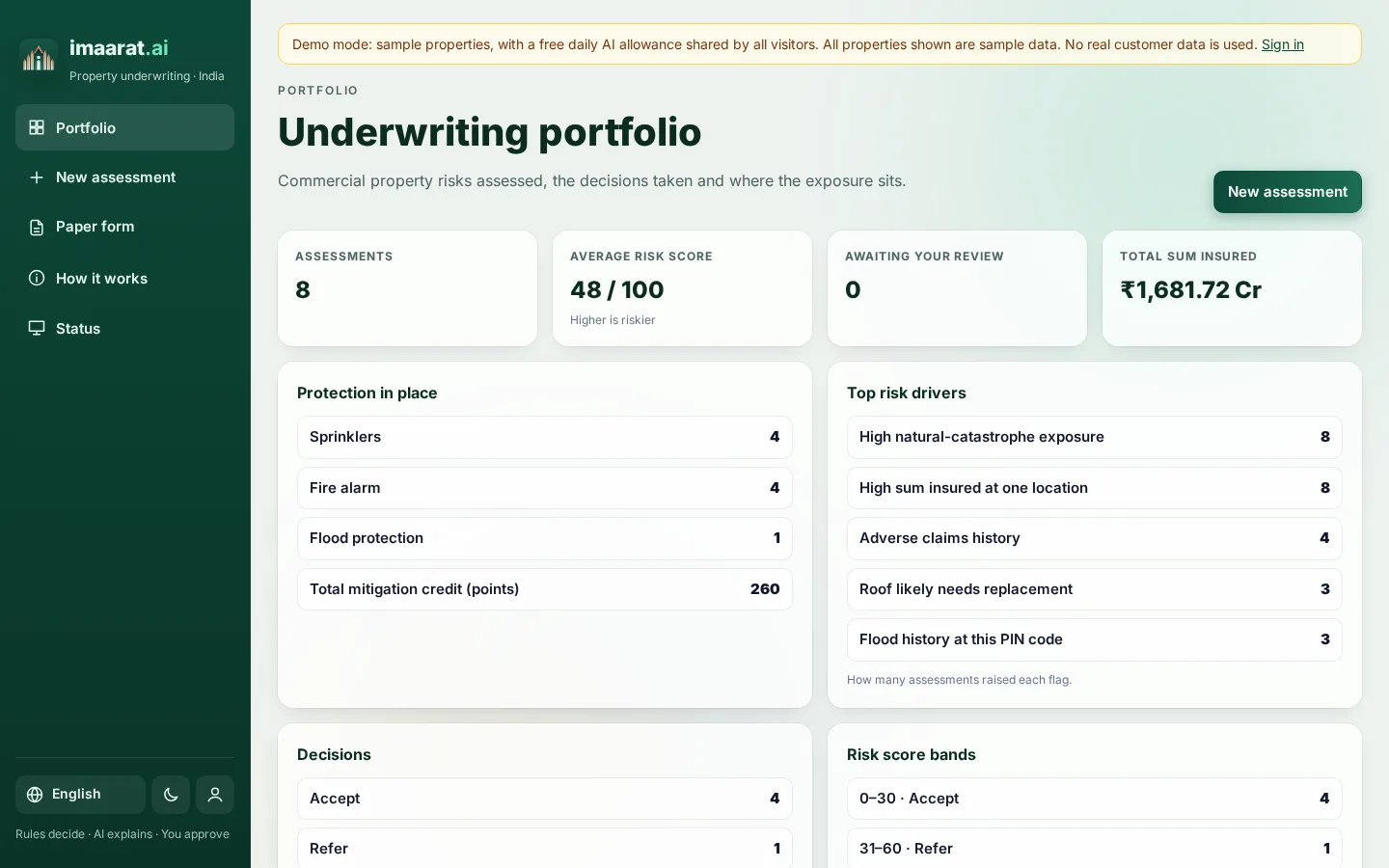
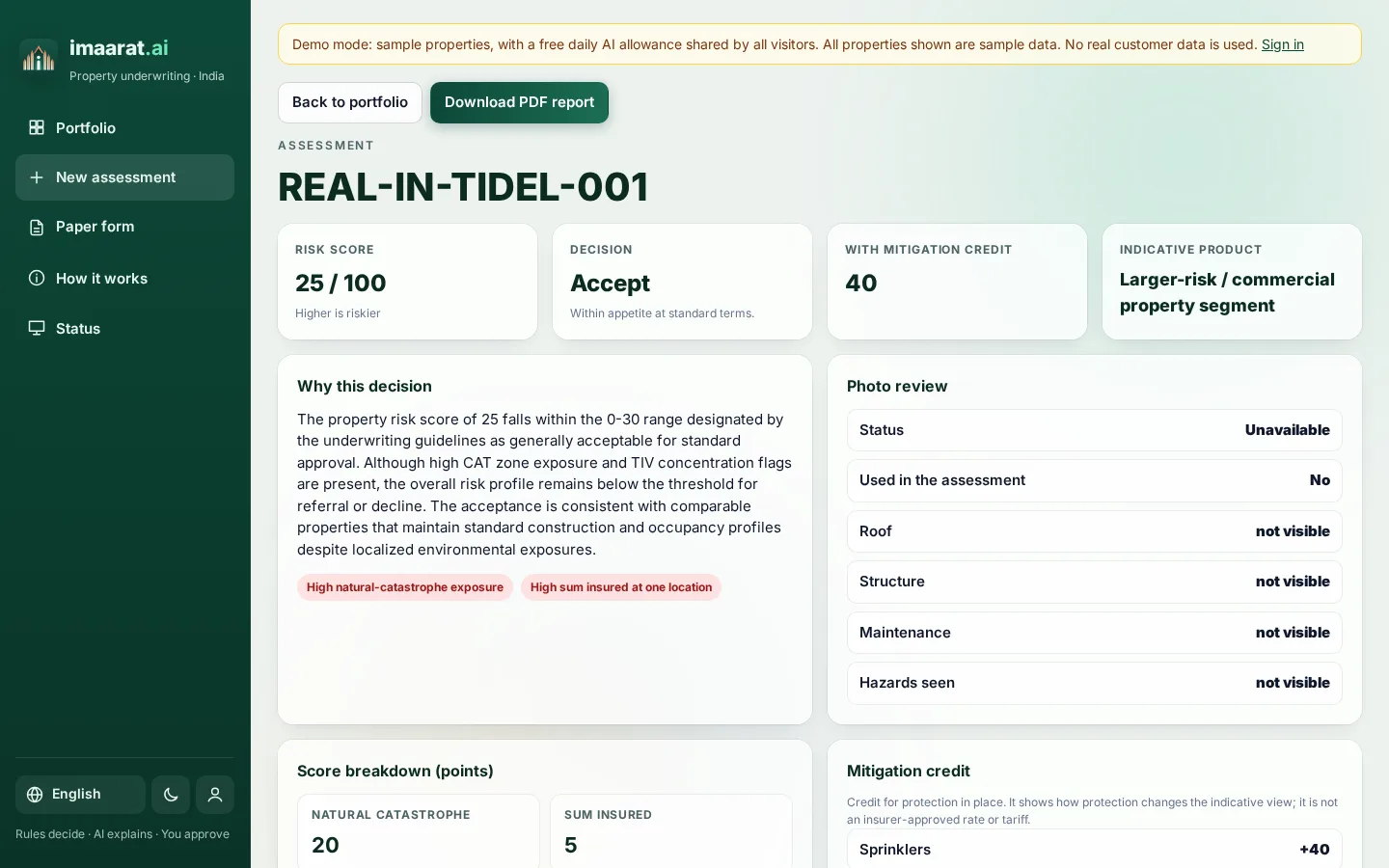
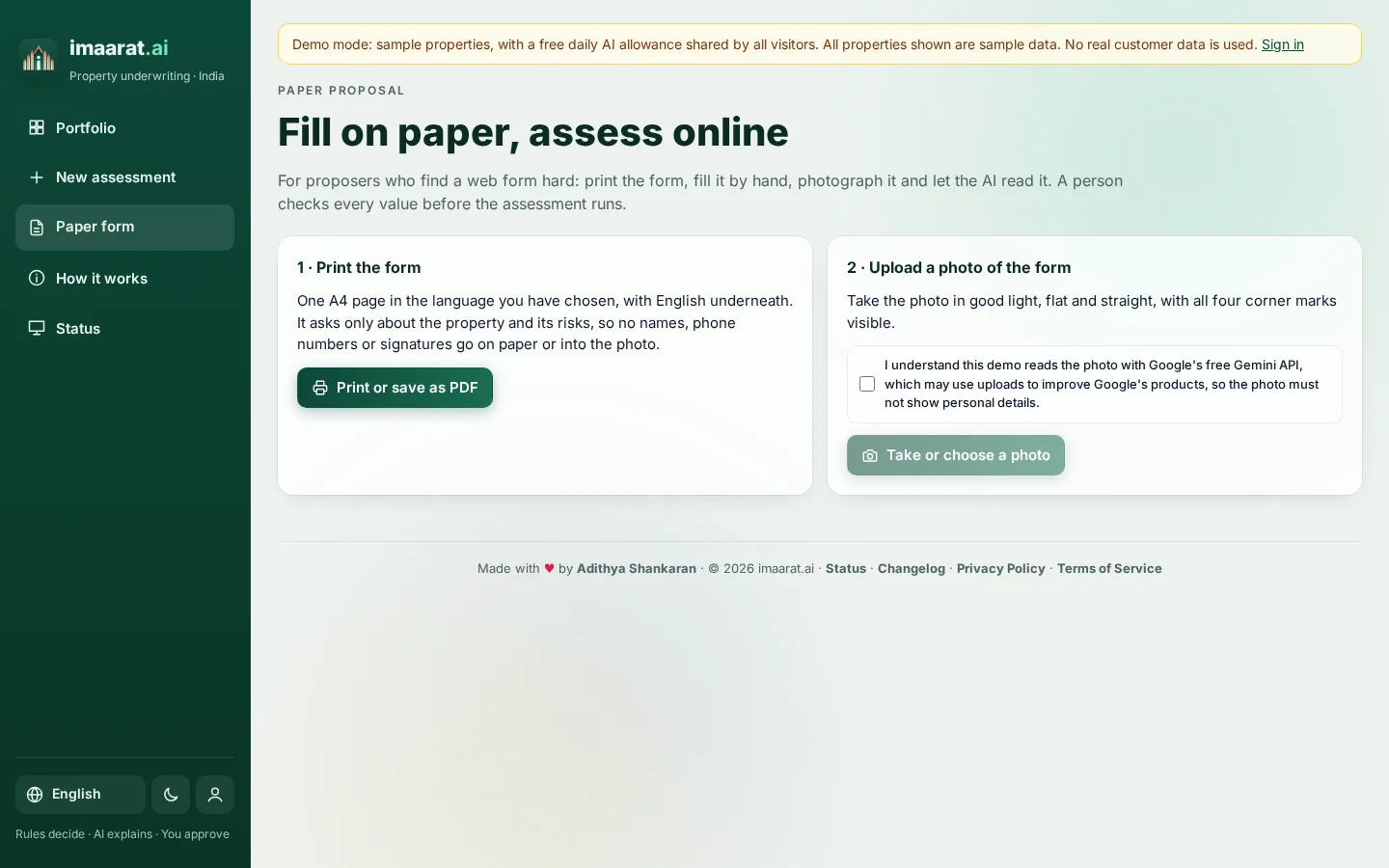
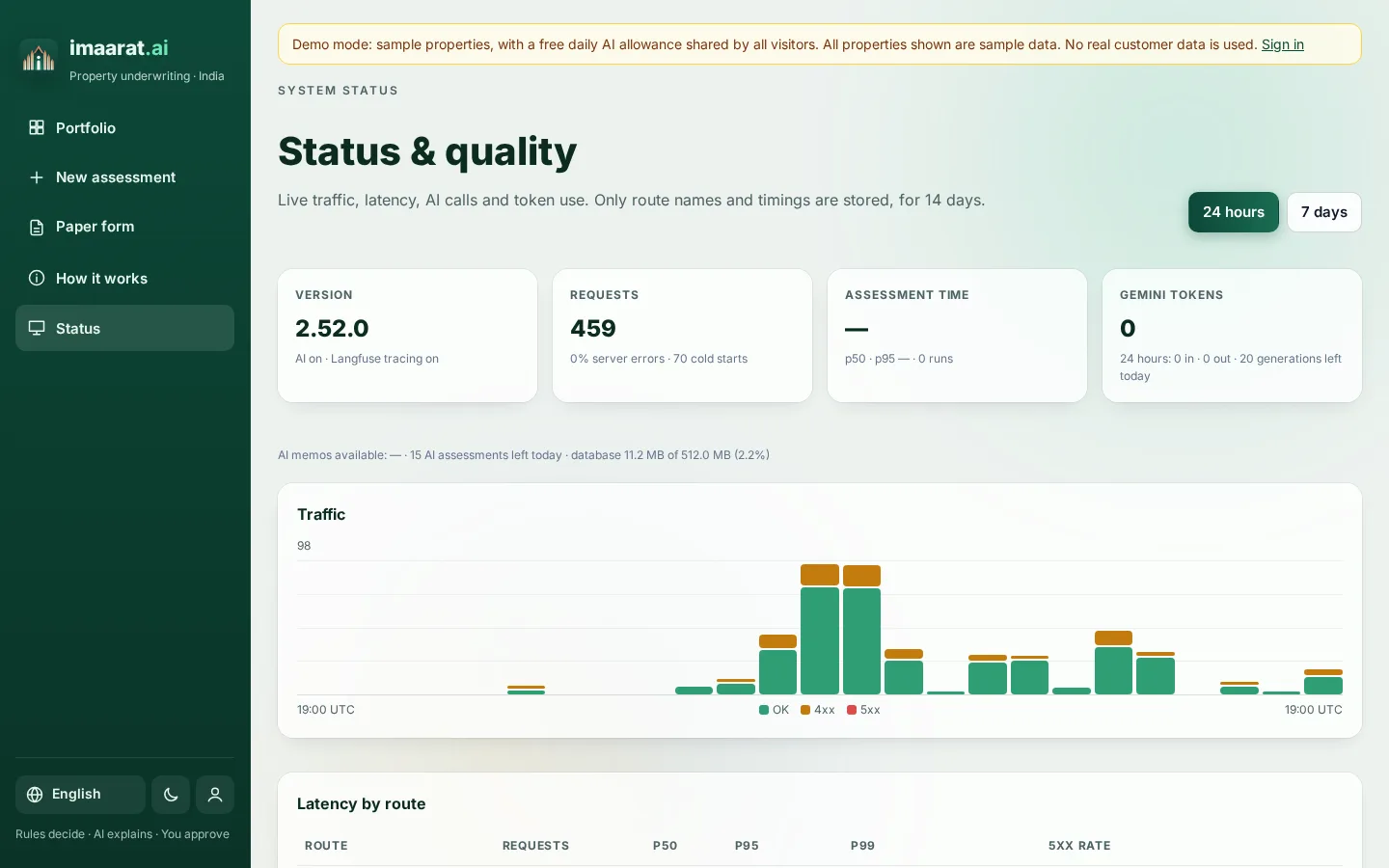

Paper forms
Handwritten proposals, read in the proposer’s language
Many small businesses still fill proposals on paper. Print the one-page form, let the owner write in their own language, and photograph it.
AI reads each field into the assessment. Nothing is used until a person has checked it.
Hazard check
Earthquake, flood and cyclone exposure from the PIN code
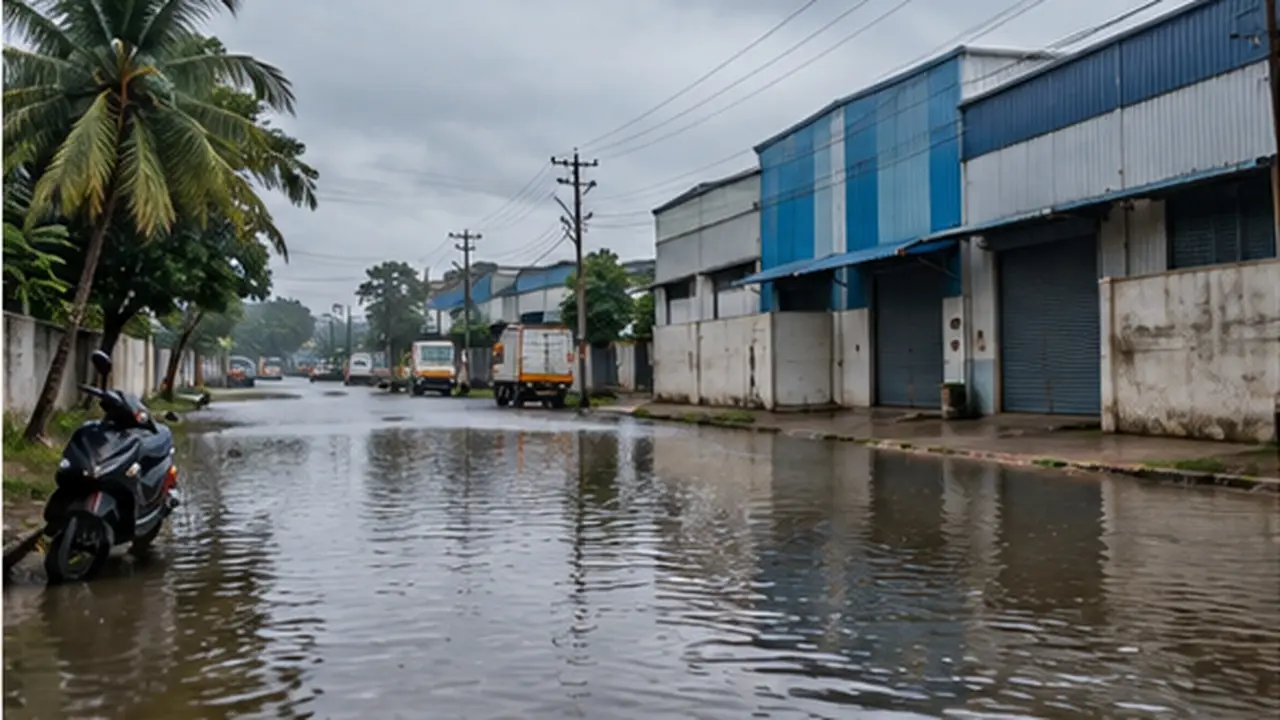
The earthquake zone comes from IS 1893, flood history from satellite-observed inundation between 1998 and 2022, cyclone exposure from IMD’s list of cyclone-prone districts, and known flooding spots from the Chennai and Bengaluru city corporations.
Every lookup names its source, so an underwriter can check it.

Explain and approve
A decision you can defend, in plain words
The score breakdown shows exactly which risks added points and which protections took them away. The AI risk summary turns that into a short explanation with the guideline it relied on.
Cases that need judgement are referred to an underwriter, and a report can be downloaded as a PDF.
Modular by design.
Six modules, each usable on its own. Shown here on one real assessment from the demo: an office at TIDEL Park, Chennai, PIN code 600113.
Paper reader
Reads a photographed proposal into fields that a person confirms.
Hazard verification
Looks up official hazard data for the PIN code, with the source of each fact.
Scoring rules
Scores the risk with written rules and shows every point.
AI risk summary
Explains the decision in plain words, using only the facts above.
“The property is approved with a risk score of 25, which falls within the standard acceptance range of 0–30 … mitigated by its non-combustible construction, office occupancy, and the presence of an active sprinkler system.”
Sign-off and reports
Referrals wait for a signed-in reviewer; every decision exports as a PDF.
Connects to your software
Your policy, broker or claims software can send a proposal and get the decision back automatically.
Who it is for.
Underwriters at insurers
Spend time on judgement, not data entry. The hazard facts, the score breakdown and a draft explanation are ready before you start.
Brokers and agents
Collect a proposal on paper at the shop counter, photograph it, and see an indicative decision in under a minute, in the client’s language.
Business owners
See why a property is rated the way it is, and how protections such as sprinklers, fire alarms or flood barriers change the picture.
Why imaarat.ai.
- Every PIN code, not only metros
- The same checks run for a taluka town as for Mumbai, because they come from national public datasets.
- Starts where Indian business starts
- Proposals filled in by hand, in the proposer’s language, are read by AI and confirmed by a person, so nothing has to be retyped.
- Decisions you can defend
- Written rules decide, the AI explains with citations, and a person signs off. Every step is recorded.
- Open and inspectable
- Open-source code, public test runs and a live status page. Run it yourself with one command, or use the hosted demo.
Built to be checked
Nothing here asks for blind trust. Each claim on this page links to something you can open.
Live status page
Requests, errors, AI calls and the time each step of an assessment takes, updated as people use it.
Open →Tested on every change
Unit tests, browser tests in several languages, load tests with up to 200 simulated users, Lighthouse audits and AI evaluations run in GitHub Actions.
Open →Open source
The code, the hazard data pipeline and every test run are public on GitHub.
Open →Questions
Does the AI decide whether a property is accepted?
No. Written rules make every decision and show the points behind it. The AI risk summary explains that decision in plain words and cites the guideline it used. Referrals wait for a person to approve them, and an override needs a note.
Where does the hazard data come from?
Public data: India Post PIN-code boundaries and earthquake zones from IS 1893 on data.gov.in, satellite-observed flood inundation from NRSC and NDEM for 1998 to 2022, IMD’s cyclone-prone districts, and flooding spots published by the Chennai and Bengaluru city corporations. Each result names its source.
What happens to the details I enter?
The paper form asks only about the property and its risks, not about people. This free demo uses a free AI service, so please do not enter personal or confidential information.
Is this an insurer’s price or quote?
No. imaarat.ai is an independent prototype. Its decisions and product segments are indicative and are not an insurer’s rate, tariff or offer.
Which languages does it support?
The app is available in English and 25 Indian languages. Reading paper forms has been tested with handwriting-style fonts in English, Hindi, Tamil, Bengali, Telugu, Malayalam and Gujarati; tests with real handwriting are next.
Why is the AI summary sometimes unavailable?
The demo shares a small free daily AI allowance across all visitors. When it runs out, or Google’s model is busy, the rules still decide and the page says so.
Try it with a sample property
No sign-up. Enter a PIN code and a few details, and see the decision, the reasons and the risk summary.
Start an assessment React
 FastAPI
 LangGraph
 Qdrant
 PostgreSQL
 Redis
 A2A
 Langfuse

 Sarvam AI
 dbt
 DuckDB
 Google Gemini